

Investment compliance rules are often built through a chain of handoffs. Compliance interprets a client’s guidelines, a technical specialist turns them into system logic, and the result goes back to compliance for testing. Every mandate amendment, new account and regulatory change sends the process back to the start.
No-code rule building shortens that chain. Compliance professionals use a configurable interface to build, test and maintain rules themselves, without writing code or waiting for IT or a vendor. The people accountable for a restriction are the people who build it, which leaves fewer places for a mandate’s meaning to change on the way to a rule.
An interface alone does not make that safe. Teams also need consistent definitions, reliable data, thorough testing and independent review. This guide covers how investment compliance rules are put together, how to build them without code, how to handle ambiguous language and overriding documents, who is accountable when a rule is wrong, and where specialist help is still needed.
Overview
Key takeaways
- Rules are built from a small set of components. Scope, grouping, numerator, denominator, limit, timing, severity and accounts describe most investment restrictions.
- Interpretation is compliance work. Deciding what “country” means, or which document governs when a side letter conflicts with the mandate, is a judgment about the client’s intent. It belongs with the people accountable for the restriction.
- Define terms once and reuse them. A shared library of definitions keeps similar rules consistent, shows which rules an amendment affects and reduces false alerts.
- Test before you submit. Run a new rule against current and past positions, and at its boundaries, before it goes for review.
- Accountability does not move. The firm remains accountable for every rule. Maker-checker approval and an audit trail record who decided what, and why.
- Know the limits. Non-technical rule building depends on the right data being in the system. Some complex calculations still need specialist support.
What is non-technical compliance rule building?
Non-technical compliance rule building is the creation and maintenance of investment compliance rules through configuration rather than code. A compliance user chooses a rule type, selects the securities and accounts in scope, decides how the limit is measured and sets the threshold. The compliance system turns those choices into executable logic.
The practice is also called no-code rule building, rule configuration or self-service rule building. It is part of what Linedata calls owner-driven compliance: compliance professionals are accountable for investment restrictions, so they create, test and maintain the rules themselves rather than relying on IT or a vendor to code every change.
Non-technical does not mean informal. A rule built this way still needs a documented source, testing, independent review before it takes effect and an audit trail.
What are the parts of an investment compliance rule?
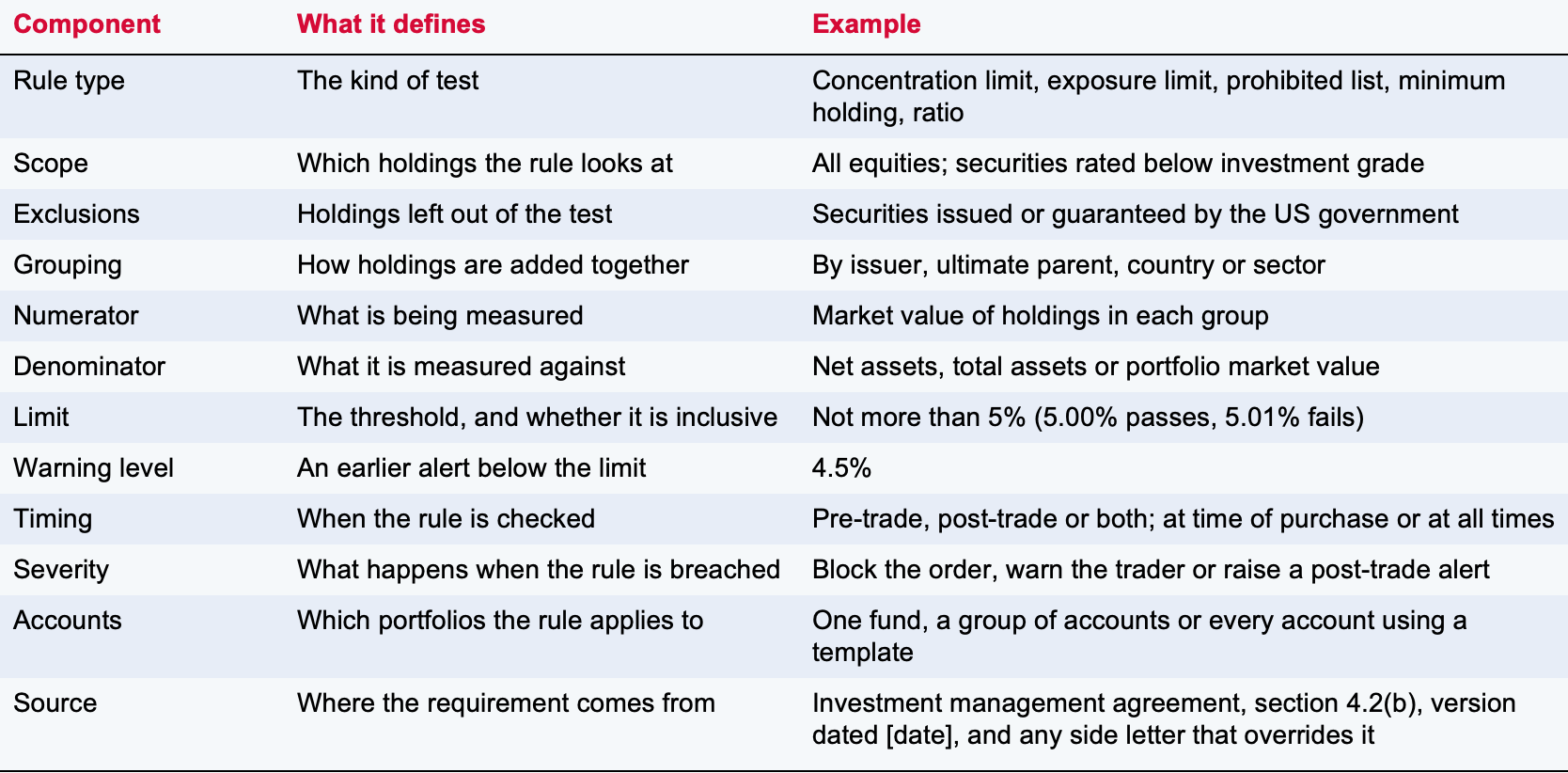
Most investment restrictions, however a mandate or regulation words them, are made up of the same components. In a no-code rule builder, each component is a field or option.
Why has rule building traditionally needed technical specialists?
Investment guidelines are written in legal language, and compliance systems need precise logic. Getting from one to the other has meant scripting, query languages or detailed knowledge of a particular platform. Consulting firms recruit for roles that call for several years of experience coding compliance rules on specific platforms, and some technology providers offer services in which their own analysts write and maintain clients’ rules. This model has three downsides:
- Waiting time. A new account or mandate amendment waits in a queue until someone with the right skills is available.
- Translation risk. The person coding the rule may not have the context to interpret the mandate, so its meaning can shift between the request and the finished rule.
- Inconsistent rules. When different people write rules at different times, similar restrictions end up built in different ways.
Inconsistent rules do the most lasting damage because they produce false alerts. Two rules that read the same term differently flag different holdings, and analysts spend time clearing alerts that trace back to how the rules were written rather than to a real breach. Deloitte describes a global investment manager whose rule creation process was disjointed, which led to duplicated rules and a large number of false positive alerts. After its rules were rebuilt on a standardized basis, the rule inventory for those accounts fell by 50%, and separating compliance monitoring from other tasks reduced FTE allocation by up to 25%. Consistent rule design matters as much as who builds the rules.
How do you build a compliance rule without code?
Take a standard issuer concentration clause:
“The Portfolio shall not invest more than 5% of its net assets in the securities of any single issuer, excluding securities issued or guaranteed by the U.S. government or its agencies. This limit applies at the time of purchase.”
The basic rule is straightforward: measure each issuer’s share of net assets, exclude U.S. government and agency securities, and set a 5% limit. Five questions need answers before the rule can be built.
- Is this clause the governing text? Check for side letters, amendments and other documents that override it for this account. A side letter might set the issuer limit at 3% for one client or add an exclusion the main agreement does not contain. A rule built from the main agreement alone would pass trades the side letter forbids.
- How should the system identify an issuer? Should it count subsidiaries separately or combine them under their ultimate parent? If a portfolio holds 4.5% in each of two subsidiaries of the same parent, the combined exposure is 9%. The compliance team decides which reading reflects the mandate.
- Should pending orders count? If two orders for the same issuer are placed on the same day, should both count toward the 5% limit?
- What happens when exposure rises above 5%? The restriction applies at the time of purchase, so a holding that exceeds 5% because of market movement is not automatically a breach. The system should block trades that would exceed the limit and flag passive breaches for review.
- Does exactly 5% pass? “Not more than 5%” allows exactly 5% and nothing above it. Test one trade that brings exposure to 5.00% and one that takes it above.
Once these decisions are made, the analyst configures the rule: the issuer grouping, the treatment of pending orders, the pre-trade and post-trade controls and the limit. They then document each decision and its source, test the rule against current and historical positions, and submit it for independent review.
How do you handle ambiguous terms in investment mandates?
Ambiguous language is one of the biggest risks in rule creation. A mandate may use a familiar term without saying how the compliance system should interpret it. “Country” could mean the country of incorporation, domicile, listing or business risk, and each can give a different result for the same security. Vanessa Macleod of Strata has highlighted this problem in her analysis of investment management agreements. Other common examples include “sector,” “minimum investment grade” and “liquid assets.”
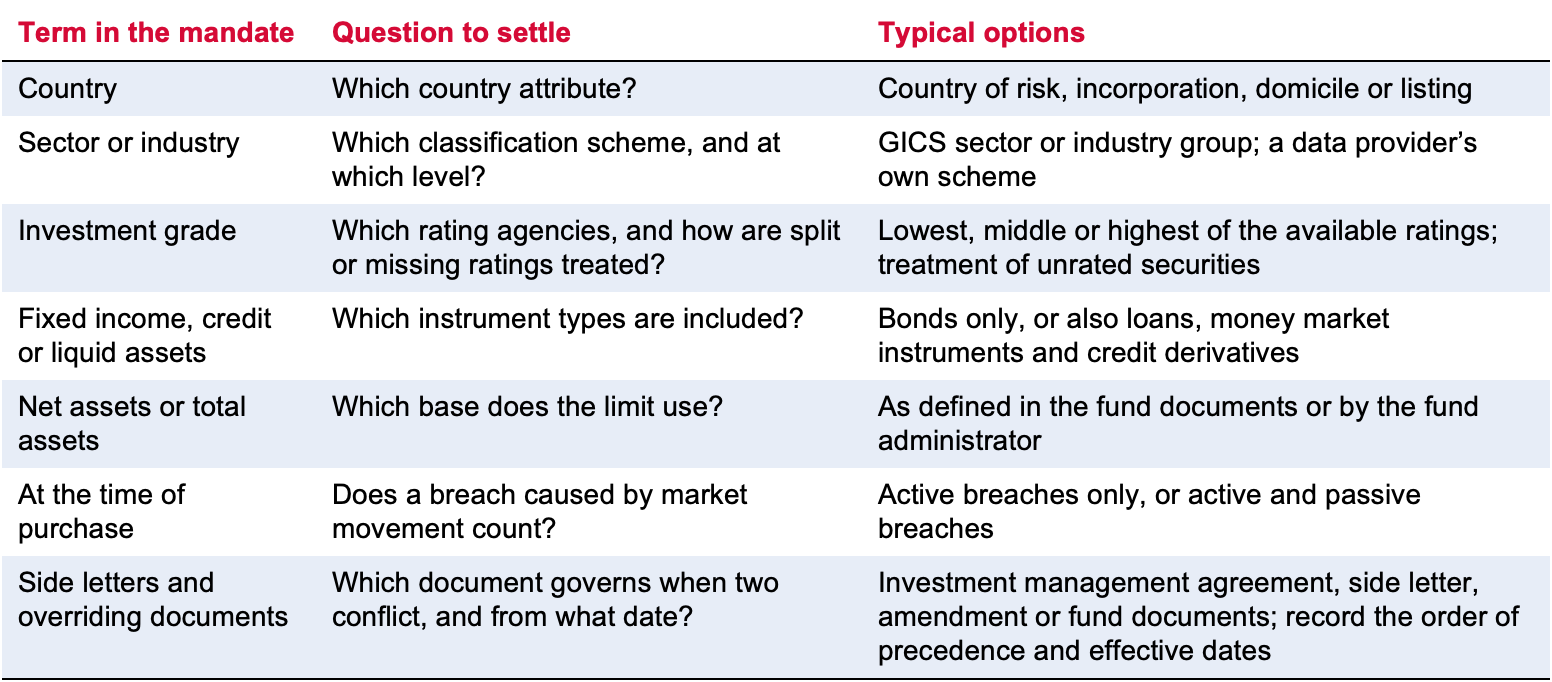
Side letters need particular attention because they sit outside the main agreement. A side letter can tighten a limit, add an exclusion or change a definition for one client, and it may be filed or stored separately from the mandate the rule was built from. For each account, record which documents apply, their order of precedence and the date each took effect, and cite those documents in the rule’s source field.
The best way to manage these decisions is a definitions library. For each client or fund range, document what key terms mean, which document each definition comes from and which document prevails when two conflict. Reuse each definition in every rule that depends on it.
The library helps in two ways. When a client amends a mandate, an impact view finds every rule that uses the changed term or clause, so the team can review all of them together instead of the ones someone remembers. And because every rule reads a term the same way, alerts reflect real exposure rather than differences between rules, which cuts false alerts.
This is also where compliance expertise matters most. Configuring a field is straightforward once the decision has been made. Determining what the client intended, and applying that interpretation consistently, requires judgment.
Example: turning the SEC Names Rule into rules
Regulatory changes often need more than one rule. The SEC’s amendments to the Names Rule, adopted in September 2023, expanded the set of funds that must adopt an 80% investment policy. A fund whose name suggests a particular focus, including terms such as “growth” or “value” and ESG-related terms, must invest at least 80% of the value of its net assets, plus borrowings for investment purposes, in line with what the name suggests.
The SEC extended the compliance dates in March 2025. For fund groups with $1 billion or more in net assets, the date was June 11, 2026. For smaller fund groups it is December 11, 2026. Under SEC staff guidance, an existing fund complies from the effective date of its first on-cycle annual prospectus update filed on or after the relevant date. Form N-PORT requirements tied to the rule have later dates, November 17, 2027 for larger groups and May 18, 2028 for smaller ones, and the SEC has proposed removing them.
The 80% policy is a ratio rule with a minimum:
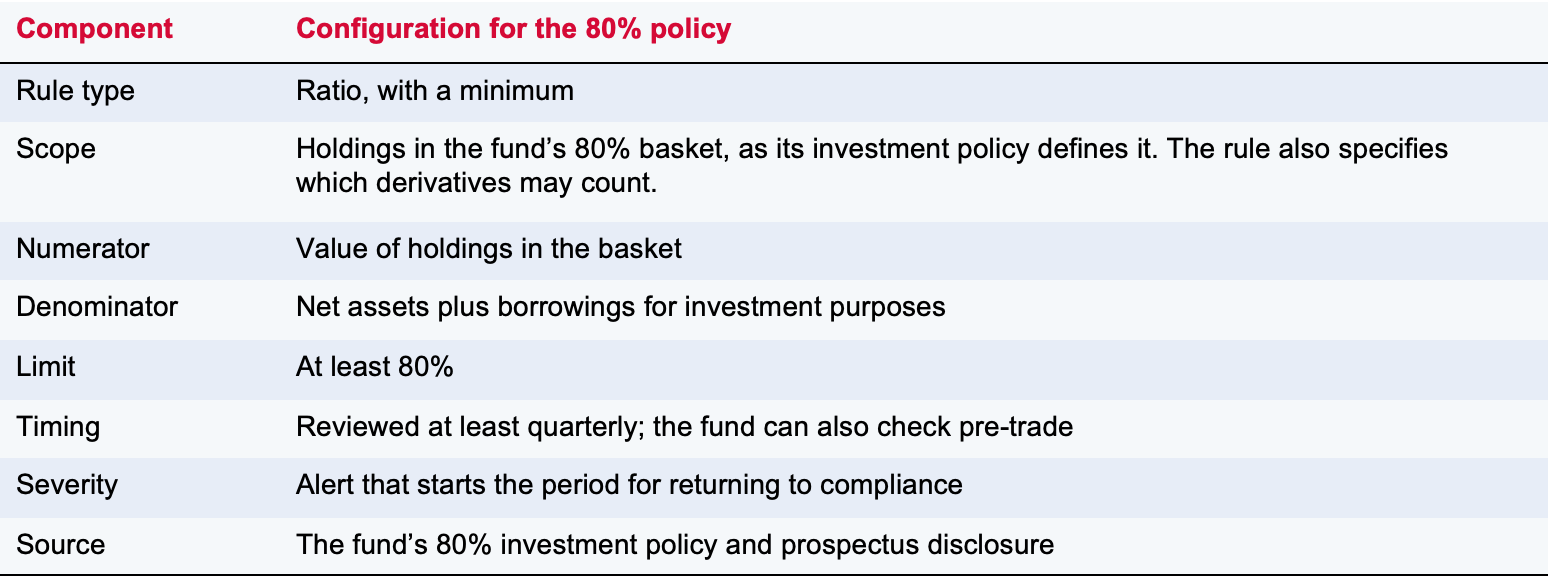
A fund that departs from its policy generally has 90 days to come back into compliance. The rule also requires records, kept for at least six years, showing whether each investment is in the basket and why, the quarterly review, and any departure from the policy and the reasons for it. An audit trail that logs each classification decision supports that requirement.
The calculation is only part of the job. The fund’s name sets what the policy has to cover, and compliance decides which holdings are consistent with that name, for example which instruments meet an ESG-related definition. Compliance must also confirm that the data supports that interpretation and that the calculation matches the fund’s policy.
How should you test a rule before it goes live?
A rule that looks right in a configuration screen can still behave incorrectly on real portfolios. Test it before submitting it for approval so the reviewer can assess actual results rather than just the intended logic. Five checks cover most routine rules:
- Current holdings. Run the rule against current positions and check a sample by hand.
- Past positions. Run the rule as of earlier dates, especially dates when you know whether a breach occurred.
- Boundary cases. Test values exactly at the limit and just above it, to confirm whether the limit is inclusive. • What-if orders. Test proposed trades that should pass and trades that should fail.
- Scope. Check which accounts and securities the rule picks up, including accounts with side letters, and look for any it should include but misses.
When results are unexpected, check the data mapping, definitions and account assignments before assuming the threshold is wrong. Resolve discrepancies and rerun the tests before sending the rule for approval.
Who is accountable when a rule is wrong?
Accountability for a restriction stays with the firm’s compliance function, and ultimately the chief compliance officer, whoever builds the rule. Owner-driven rule building changes how clearly that accountability can be shown.
Suppose a rule is found to be wrong, for example because it grouped issuers by subsidiary when the mandate meant ultimate parent. Three things follow:
- Breaches. Re-run the corrected rule against past positions to find every date the original rule missed a breach, and for which accounts. Separate active breaches from passive ones using the mandate’s own terms.
- Client notification. The investment management agreement and the firm’s policies set when and how a client must be told. The re-run identifies which clients are affected and by how much, so compliance and legal can decide timing and wording on facts.
- The record. Under maker-checker approval, one person builds or changes a rule and a second approves it before it takes effect. The audit trail records who changed the rule, when, and on what source, and breach management records the decision on each alert. Who approved the rule, and on what basis, is answered from the record rather than from recollection.
The risk for a CCO is not that analysts build the rules. It is a rule that no independent person has reviewed. Our guide to maker-checker approval covers how to structure that review and how the record holds up in regulatory examinations.
What are the limits of non-technical rule building?
No-code rule building can cover much of a compliance team’s routine work, but it does not remove the need for technical support. Three things determine what a team can handle independently:
- The data has to be in the system. A rule cannot test an attribute the system does not hold. ESG flags, look-through holdings for funds and derivative exposures all need a reliable data source.
- The rule type has to be supported. Concentration limits, exposure limits, prohibited lists and ratios suit configuration well. A bespoke calculation, such as a client-specific risk measure, may need a formula builder or specialist help.
- Governance still applies. When rule changes are easier to make, review matters more, not less.
How does AI fit into rule building?
AI tools can read a mandate, find the passages that describe restrictions and suggest how each one maps to rule components. That speeds up the first step of rule building. It does not replace the judgment involved in interpreting the restriction, or the need for review.
In Linedata’s beta testing of an AI workflow for mandate documents, the AI identified 95% of relevant restriction candidates in sample documents, averaging under eight seconds per restriction. A compliance professional reviewed each suggestion and mapped confirmed restrictions to rule logic.
The quality of AI suggestions depends on the groundwork. Macleod argues that firms should standardize how restrictions are defined before relying on AI to extract them. A firm with a maintained definitions library and a set of rule templates is in a better position to use AI than one without them.
How Linedata Compliance supports non-technical rule building
With Linedata Compliance, compliance teams can:
- Start from a rule library of more than 250 pre-packaged, configurable rules covering global jurisdictions.
- Build and maintain their own restrictions with a rule builder designed for non-technical users, and a formula builder for custom calculations.
- Find every rule affected by a mandate amendment or a changed definition through an impact view.
- Test before go-live by running rules in real time or as of a historical date, and by checking what-if orders against limits.
- Review every change, with new and modified rules going through maker-checker approval before they take effect.
- Keep a full record through electronic audit trails covering rule history and breach management.
- Use AI to draft from mandates with Linedata’s AI Compliance Assistant, which supports guideline extraction and rule mapping, with compliance professionals reviewing each suggestion.
For more information on Linedata’s owner-driven compliance solution, chat with our team.
Frequently asked questions
Who is responsible if a rule built in a compliance system is wrong?
The firm. Responsibility for what a rule says stays with the firm’s compliance function, and the vendor is responsible for the platform performing as specified. Contract terms vary, so ask what the vendor’s responsibility covers. A CCO can reduce exposure with periodic recertification: each year, and whenever a mandate changes, a reviewer who did not build the rule confirms it against the current mandate, side letters and definitions library, and records the result.
How long does it take to onboard a new account?
It depends on how much of the mandate matches rules you already have. An account whose guidelines fit existing templates mostly needs its definitions confirmed, its accounts assigned and its tests run. The slowest step is usually interpreting non-standard clauses and locating side letters, not configuring the rule. To set a baseline, time one account you have already onboarded and split the hours into interpretation, build, testing and review.
Can I test a rule builder on my own mandates before committing?
Yes, and it is the most reliable way to evaluate one. Bring five to ten real clauses, including one with an ambiguous term, one affected by a side letter and one that needs a bespoke calculation. Build them as an analyst on your team would and run them against past positions where you know whether a breach occurred. Record how many clauses you finished without specialist help and how long each took.
How do I migrate existing rules from another compliance system?
Start with an inventory of live rules and their sources. Most inventories contain duplicates and rules nobody can trace to a mandate, and consolidating those before you rebuild reduces the rule count. Rebuild from templates rather than copying logic line by line. Then run the old and new systems side by side on the same positions, compare the alerts and explain every difference before you cut over. Data feeds and bespoke calculations are where specialist help is most likely to be needed.
Do compliance analysts need technical skills to build rules?
Not programming. Analysts need to read a mandate closely, know which data fields the system holds and understand how each rule component affects the result. Mandate interpretation is the skill that is hardest to hand to anyone outside compliance, and analysts already have it.

Scott Greenwald, CMO at Linedata, works closely with the company’s product and client teams to understand the operational and regulatory challenges asset managers face across the front, middle and back office. He writes about how investment firms can apply technology to investment compliance, operational oversight and the wider changes taking place in asset management.
